

I wanted AI code review I could actually own.
Not access through a subscription or a black-box service with its own limits. The deployment, credentials, providers, and usage under my control.
I kept hitting usage limits mid-week during deep building sessions. The models were capable. The workflow was useful. But access still depended on somebody else's weekly allowance, and centralized platforms can change whenever the company behind them decides to. Pricing, quotas, models, plan boundaries.
A workflow that fits this month may sit behind another subscription next month. I could not find a reliable open-source option that gave me the ownership model I wanted. So I built one.
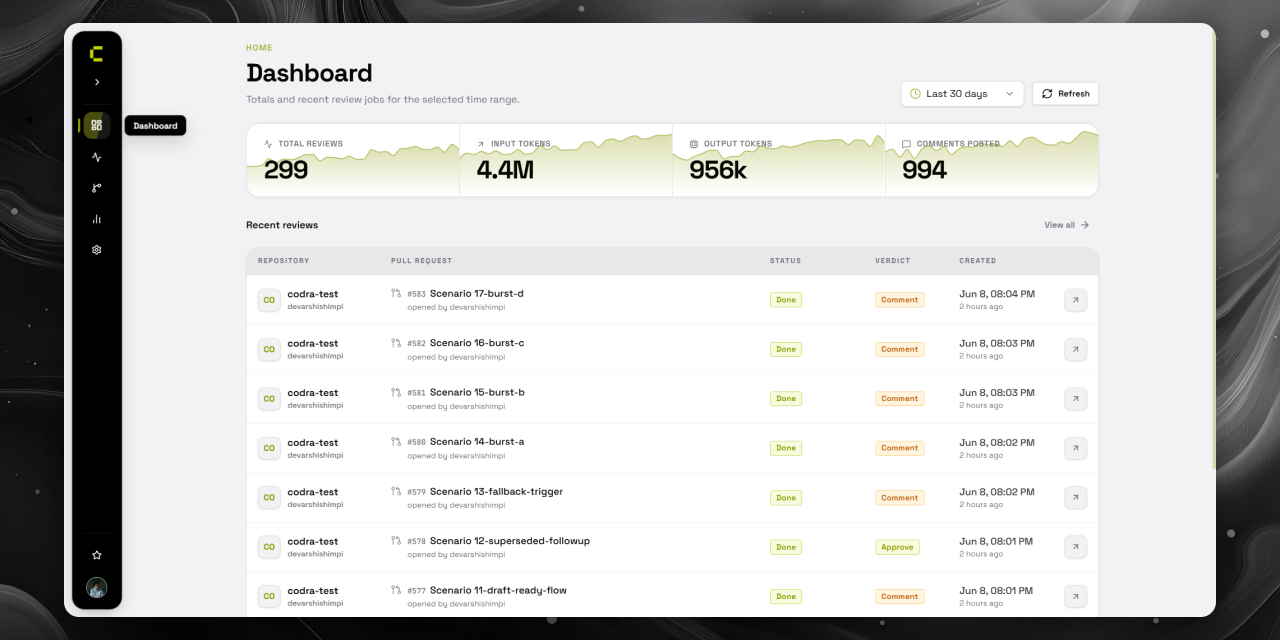
That became Codra: A self-hosted AI review engine built around bring-your-own models, your own data boundary, and no Codra-imposed usage ceiling.
What Codra Is
Codra is an open-source, self-hosted AI code review engine for GitHub pull requests.
It listens to pull request events, reviews changed files, posts inline findings, and provides a dashboard for jobs, repositories, model routing, history, usage, and failures.
It runs on Cloudflare Workers and uses:
- Cloudflare Queues for review jobs
- PostgreSQL through Hyperdrive for storage
- KV for sessions and cache
- A React dashboard for operations
The GitHub App, model credentials, database, and review history are yours. Provider keys are encrypted with AES-GCM using your deployment secret.
Bring Your Own Model, Bring Your Own Limits
Changing providers does not require replacing your review history, configuration, or workflow.
You configure the provider and model. Supported:
- OpenAI-compatible APIs
- OpenRouter
- Anthropic
- Google / Gemini
- Cloudflare Workers AI
Why Self-Hosted Matters Here
A large frontend repo and a tiny backend repo should not need the same review strategy.
Each repository gets its own review settings. You tune triggers, skip generated files, ignore drafts, use mention-triggered reviews, configure labels, set file limits, and define custom rules.
What Codra Actually Does
Codra is not just a prompt wrapped around a diff.
It includes the pieces needed to operate AI review as a system:
- Automatic and mention-triggered reviews
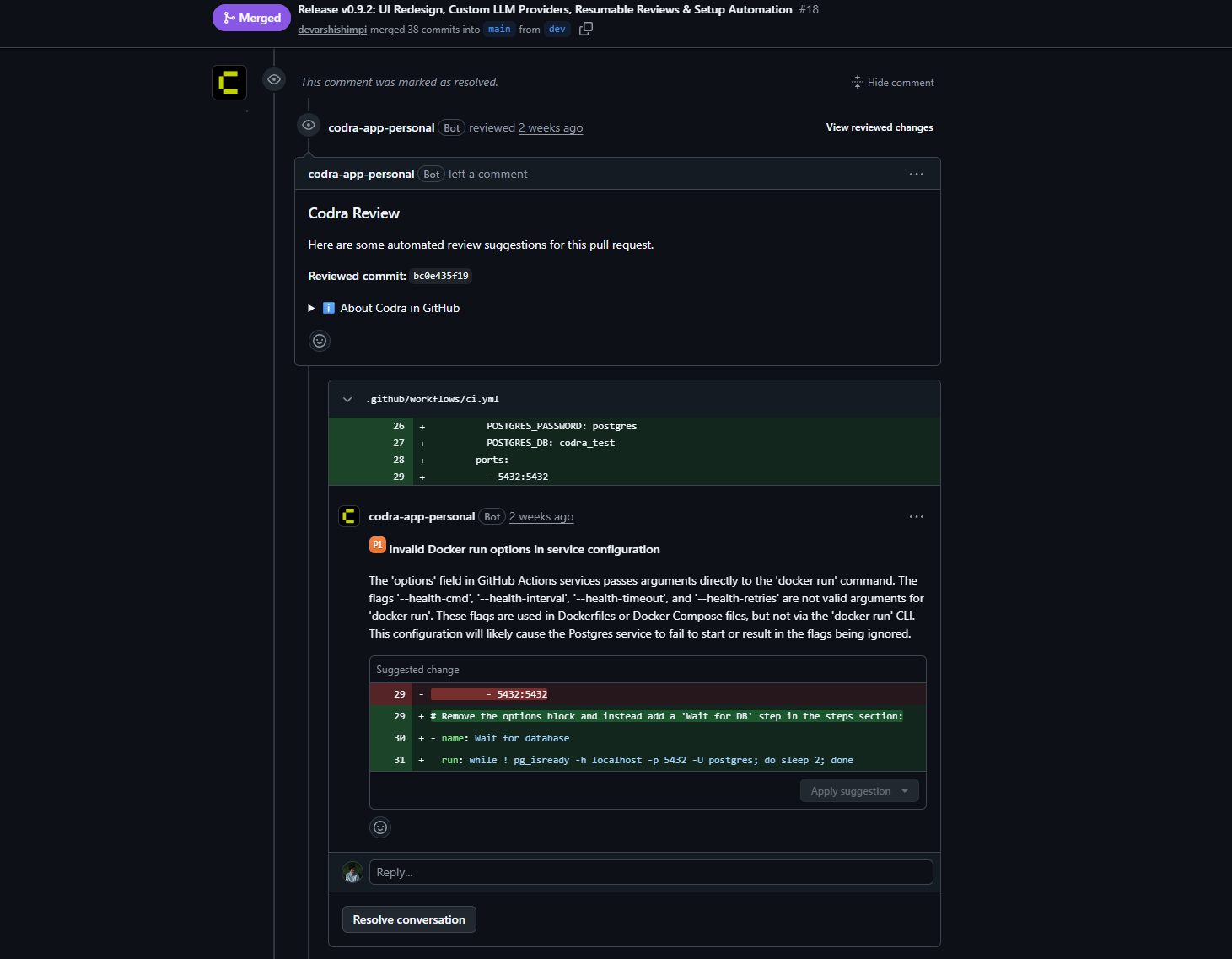
- Inline comments, summaries, and check runs
- Per-repository rules and skipped paths
- Provider fallbacks and size-based model routing
- Queue-backed, chunked processing with retries
- Dead letter queue recovery
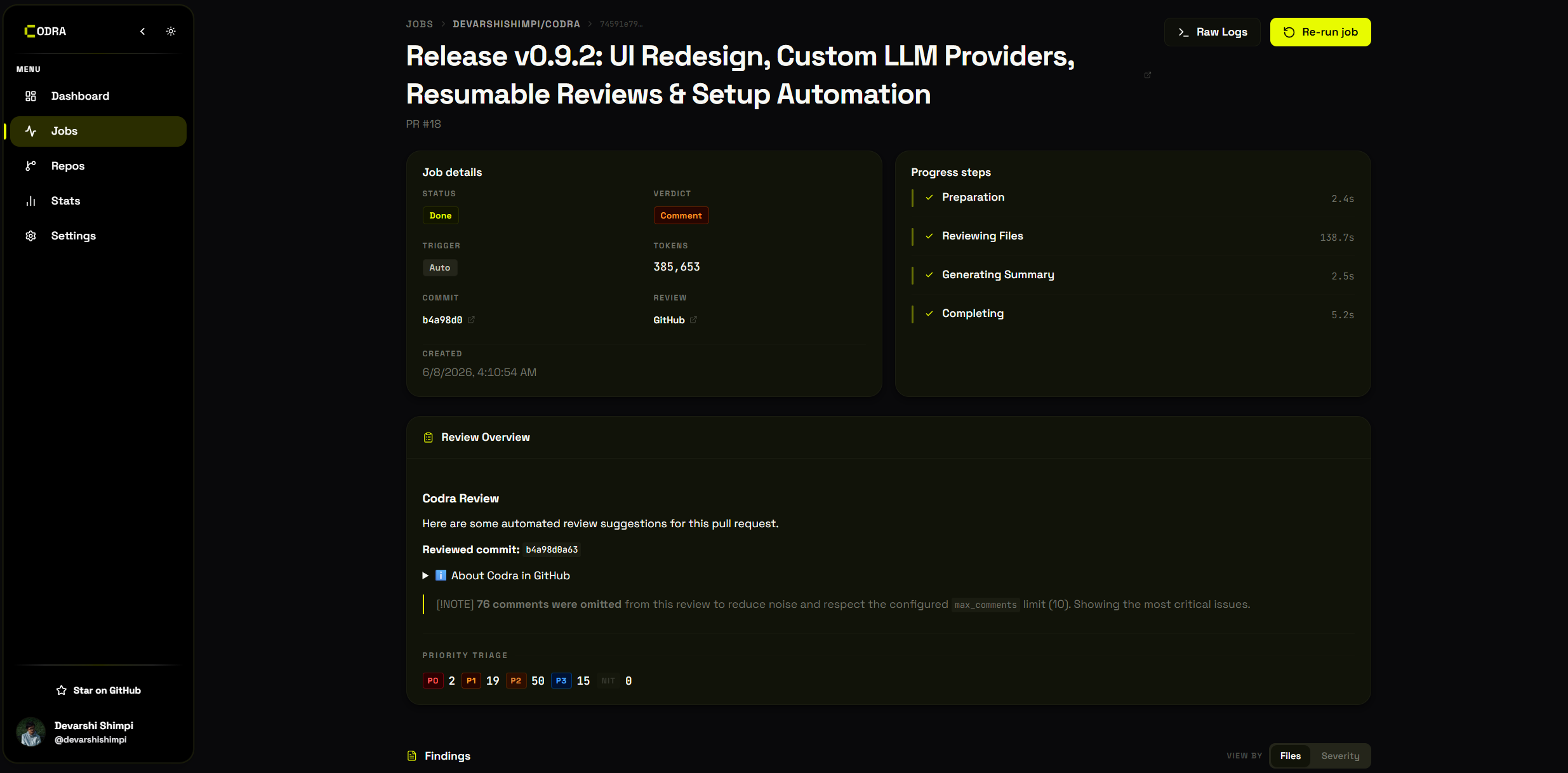
- Job history, usage, repository, and model dashboards
The boring pieces are the point.
Production software is mostly unhappy paths: provider outages, malformed output, large diffs, stale jobs, superseded reviews, and failed queue runs.
Codra exists because those details matter.
Open Source Is Part of the Product
Codra is AGPL-licensed because "own your AI review loop" only means something when the system is inspectable.
Developers can inspect how jobs, diffs, prompts, fallbacks, comments, failures, and repository settings work. AI code review is still early, and those questions are better answered in the open:
AI code review is still early. There are open questions everywhere:
- Which models work best for different kinds of PRs?
- How strict should automated review be?
- How should local models and repository context fit in?
- How do we reduce noise without missing real bugs?
Those questions are better answered in the open.
Codra should improve through real codebases and community contributions to prompts, providers, docs, tests, and defaults.
What Comes Next
Still in beta, but the foundation is there. The next phase has three tracks.
The next phase has three main tracks.
Deployment Targets
Cloudflare Workers stays the primary target. These paths are for teams and individuals who want to run Codra on infrastructure they already control.
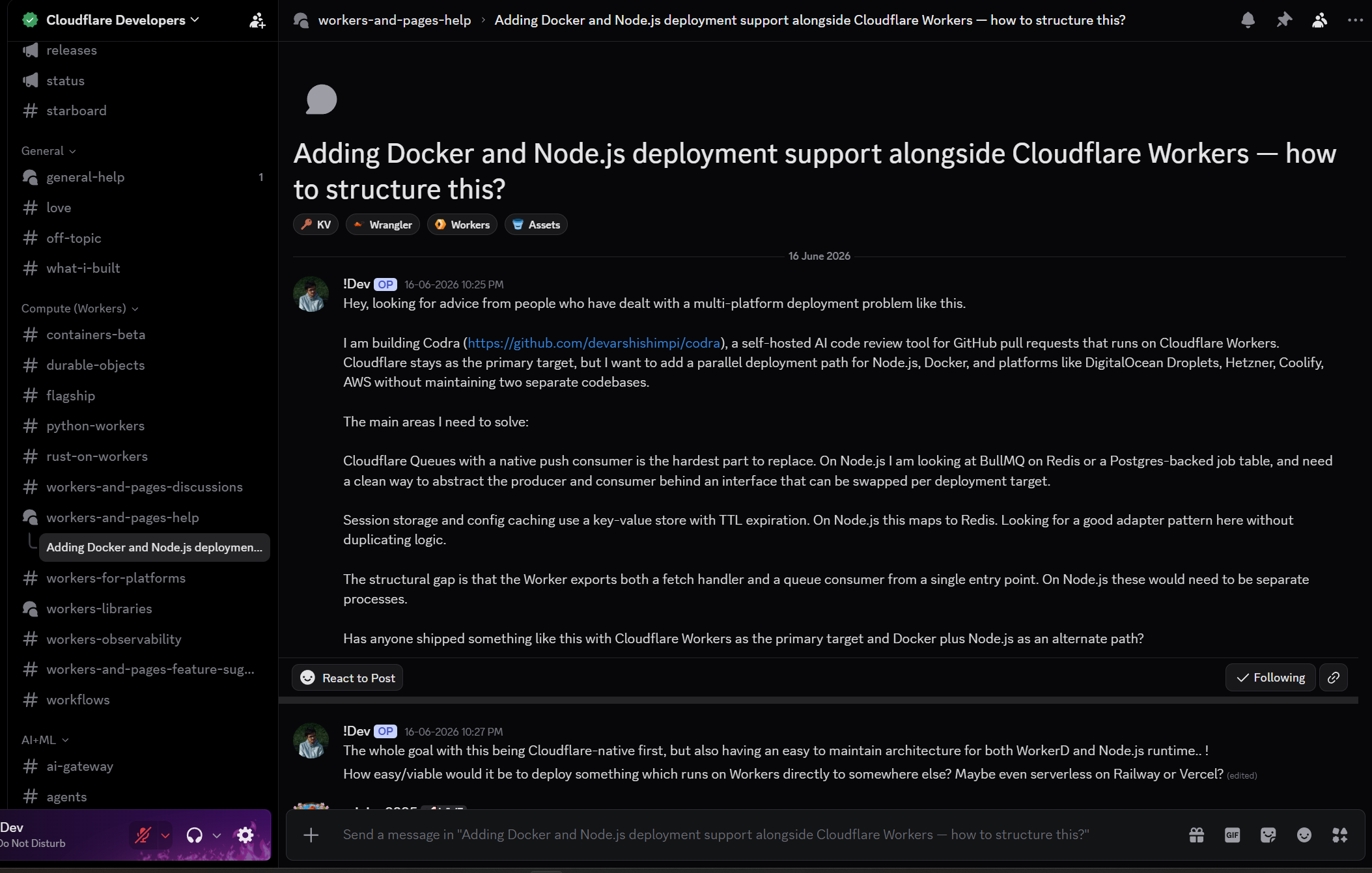
- Vercel Functions adapter and other serverless runtime support
- Conventional server deployment via Node.js and PM2 for EC2 or any VM
- A Docker-first deployment path for platforms like Hetzner, DigitalOcean, and Coolify
Stability and Developer Experience
The review pipeline works. The focus now is making it hold up under real-world load and easier to get running without friction.
- A more robust pipeline that handles large PRs reliably
- Cleaner installation, configuration, and debugging flows for first-time deployers
- Community-driven defaults and real-world review config examples
Provider and Model Support
Inference should not be locked to hosted APIs. Local and self-hosted models will become a first-class option alongside the existing provider list.
- Improved support across existing providers
- Routes for local and self-hosted models, Ollama, LM Studio, and similar
- More language-aware review behavior per file type
Own the Review Loop
Providers, pricing, and quotas will keep changing. Your review engine should not have to change with them.
Codra is open source on GitHub. Try it, star it, break it, file issues, and help shape where it goes next.
Docs: https://codra.run/docs
Read more
This article was originally published at https://devarshi.dev/blog/codra-self-hosted-ai-code-review
to interact with this post.
Topics included
Social.
Snapshot.
Instantly create a share-worthy social post for this post.

Explore similar content

How to Grow as a Better Prompt Engineer
As software engineers, we must realize that AI isn’t “free.” Running these models consumes tokens, and burning tokens costs significant money. Optimizing our token usage isn’t just about efficiency — it’s about fiscal responsibility. The harsh truth is this: The quality of output you receive from an AI is directly proportional to the quality of the input you provide.

Notion AI agent safe trial with 20 mins autonomous work permissions structure and review
Notion just rolled out “Agents,” a major update to Notion AI that can actually take actions in your workspace. These agents can run multi-step tasks for roughly 20 minutes at a time and use your pages and databases as memory. Think meeting notes pulled together, feedback organized into a table, or a project brief drafted and filed in the right place.
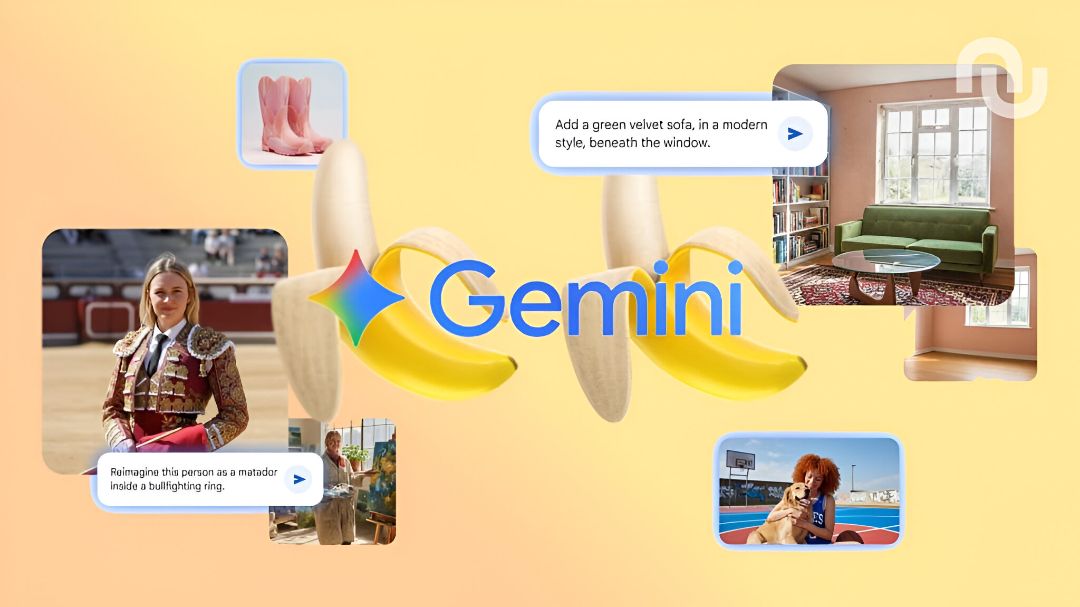
Adobe integrates Google's mysterious 'nano-banana' AI model
Adobe has launched Google's Gemini 2.5 Flash Image model in its Firefly and Express platforms, marking the immediate commercial availability of the advanced AI technology that had been secretly dominating image editing leaderboards under the code name "nano-banana."

How One Comment Changed My Typing - Journey from 30 to 80 wpm
I used to type very slowly and awkwardly. My fingers often stumbled over the keys, mistakes were common, and I couldn’t keep up with the pace I wanted. At the time, I didn’t think much of it—typing was just something I did, and that was that. Little did I realize how much this was holding me back.

Why Excessive Pornography Consumption Is Harmful to Your Health
In an age where digital content is at our fingertips, pornography is more accessible than ever. While it's easy to brush off occasional use, excessive consumption of porn can have a profound impact on both mental and physical health. Here’s why it’s crucial to understand the dangers of porn addiction and the negative effects it can have on your life.